
An Impromptu Evening in Vancouver: Conversations That Matter
by Jason Zuidema (NAMMA)
Layovers are usually something to endure rather than savour. Airports blur together, time zones collapse into one another, and the goal is simply to get from one gate to the next with as little friction as possible. But occasionally a layover becomes something else entirely—a small window that opens unexpectedly.
That was the case on my journey from Hong Kong to Montreal, when a long layover in Vancouver offered just enough time to step outside the airport and into the life of the port. With a few hours to spare, I reached out to Peter Smyth, chaplain of the Mission to Seafarers Vancouver, and asked—entirely unplanned—whether it might be possible to drop by. Peter welcomed me without hesitation, and what followed was an evening that quietly but powerfully illustrated the enduring value of presence, conversation, and companionship in seafarers’ welfare.
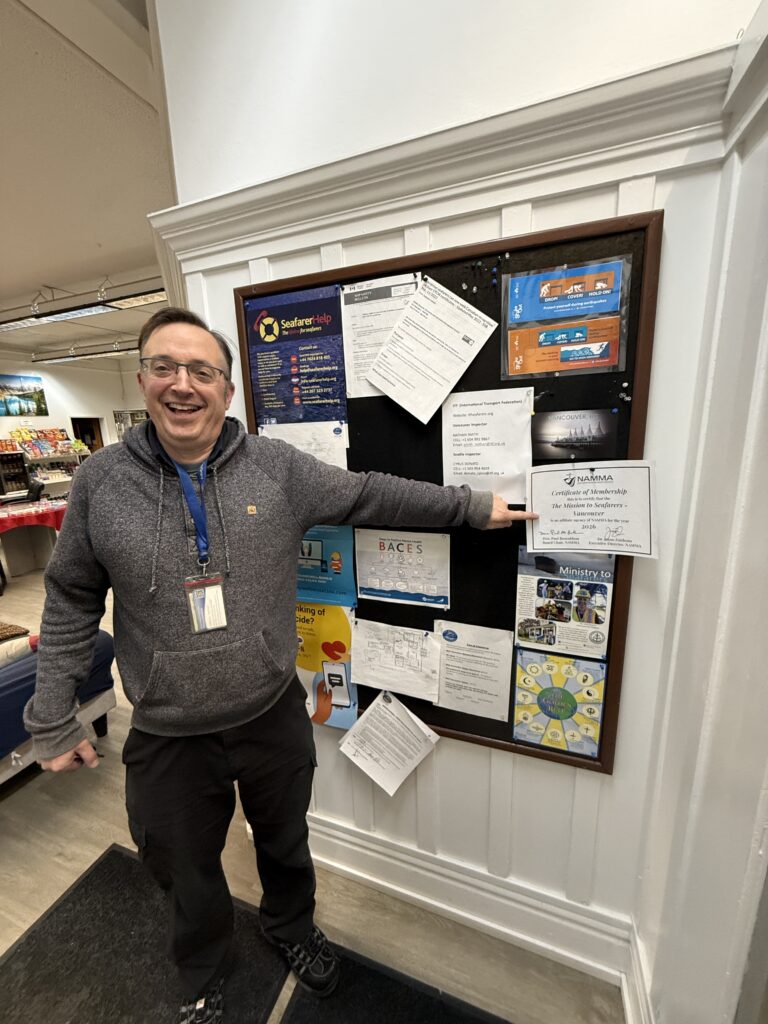
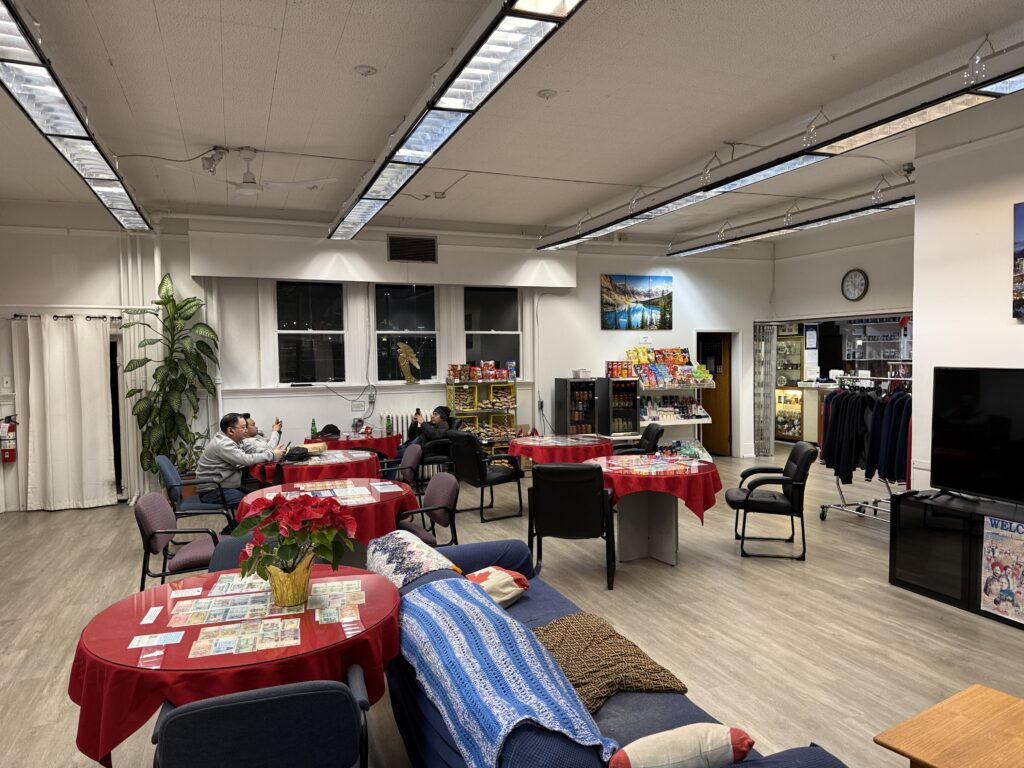
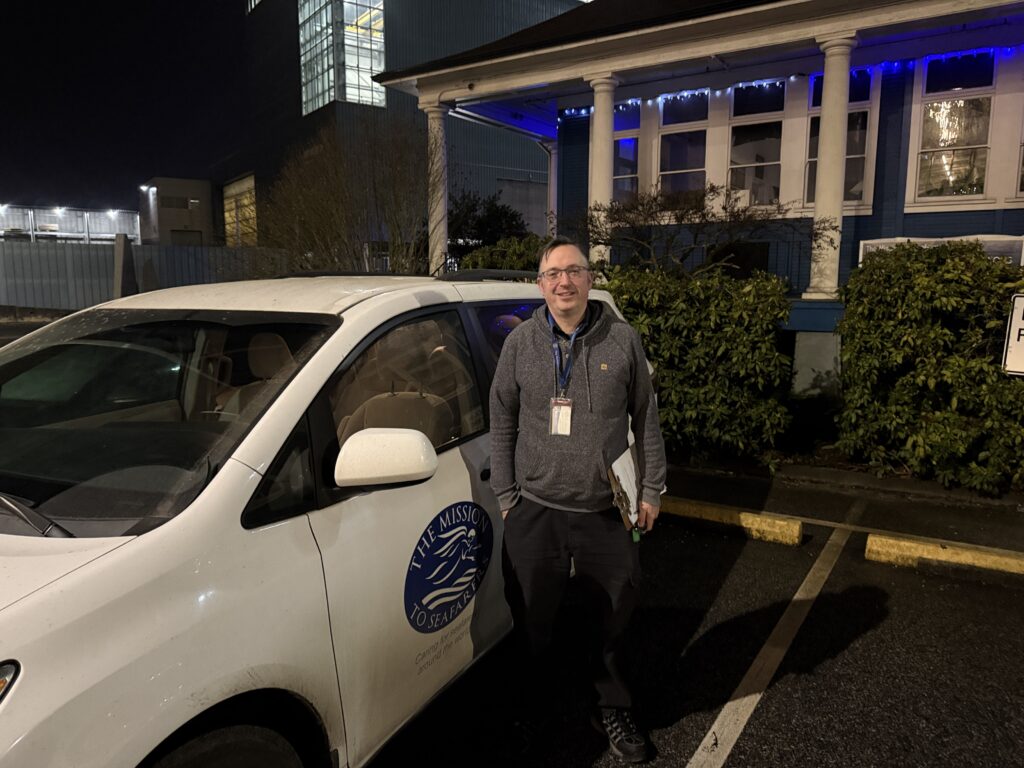
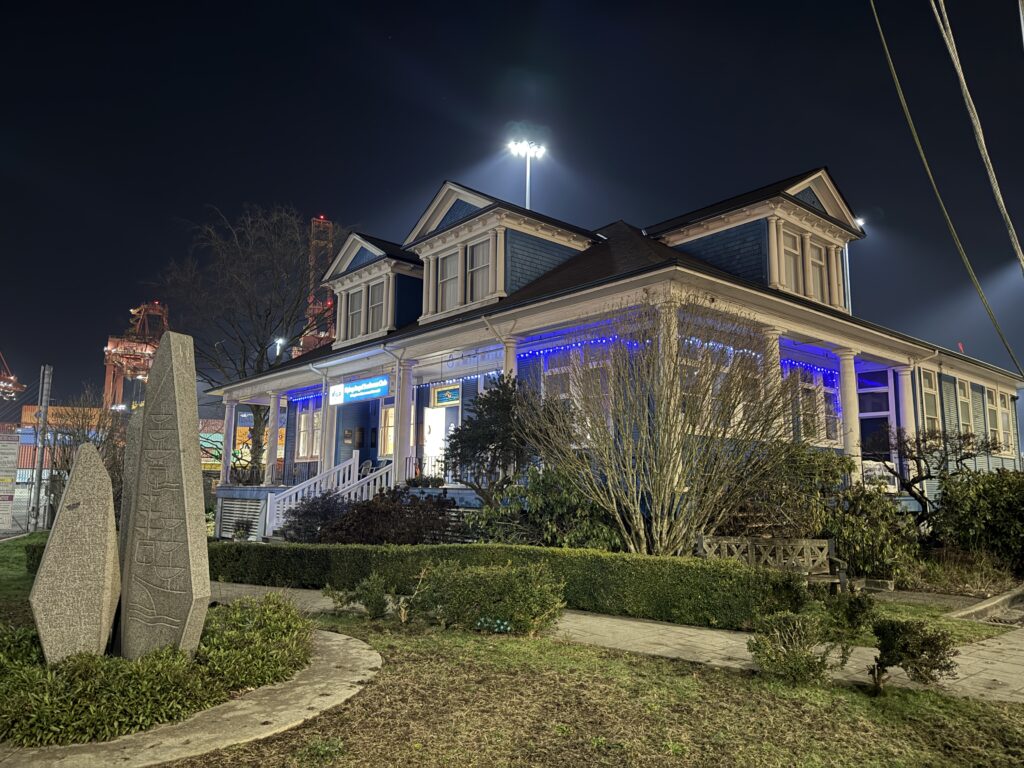
The Mission to Seafarers building in Vancouver is itself a kind of witness. Housed in a historic structure in the city centre, it carries a half a century of stories within its walls. Ships, crews, technologies, and ports have changed dramatically over that time, but the basic human needs that bring seafarers to the mission remain strikingly consistent. When I arrived, Peter was there to greet me, and we settled into an easy conversation about the port, the mission, and some of the broader trends shaping seafarers’ welfare today. It was the kind of conversation that happens most naturally between people who share both a vocation and a curiosity about how that vocation is changing.
Peter spoke about the scope of the Port of Vancouver and the way the mission has adapted to its geography and complexity. “The mission’s been here for over 100 years, serving the needs of seafarers,” he explained. “We have one centre near downtown. We have another centre a little further out, because the port covers quite an area.” The work itself is familiar to anyone involved in port-based ministry: helping seafarers change money, providing information about the city, and answering the steady stream of practical questions that arise when someone has only a few precious hours ashore. Yet Peter emphasized how essential it is for chaplains to be well informed. “We need to be informed to be able to share that information about the city—where they can get things, when things open, when things close,” he noted.
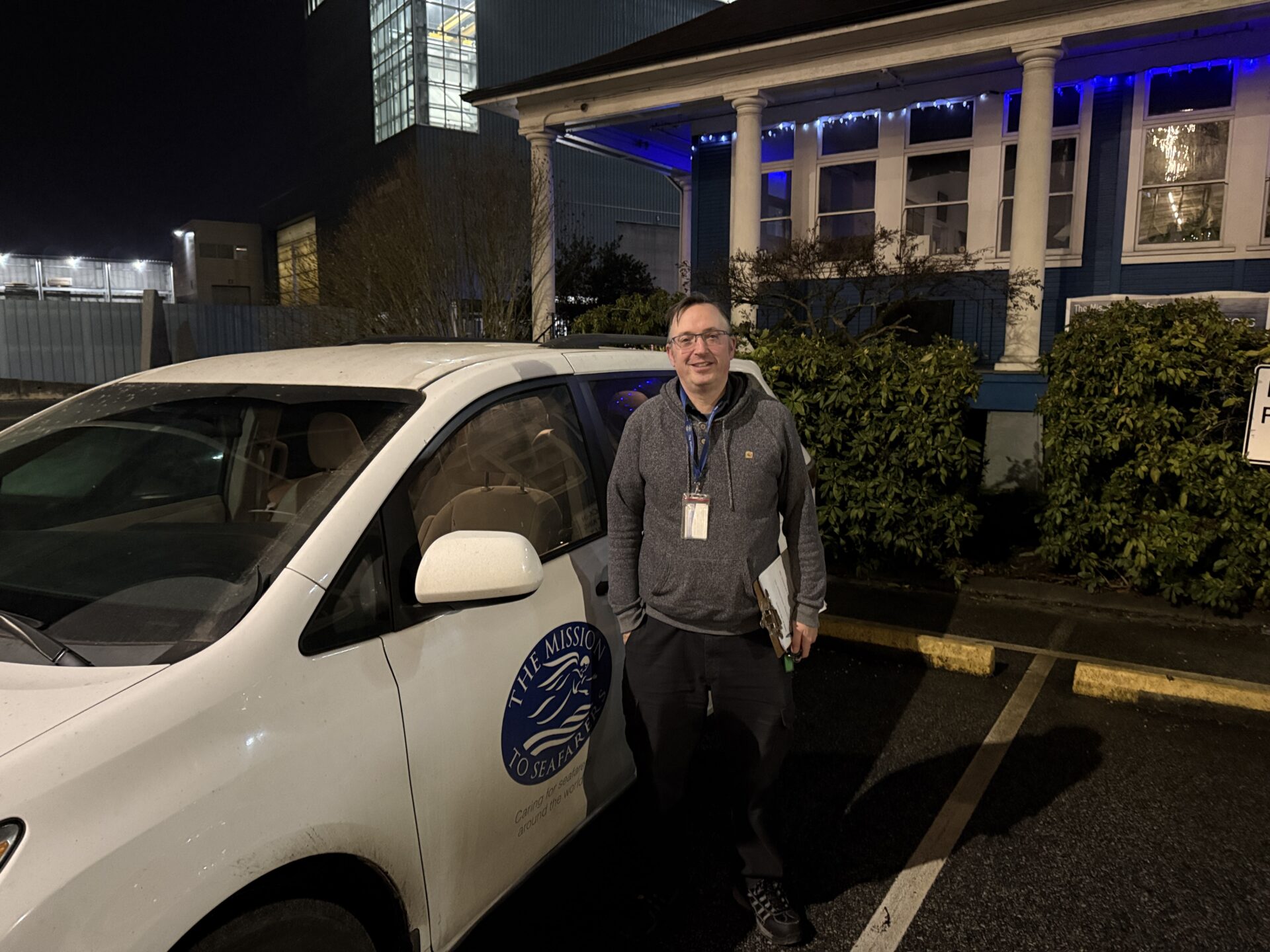
As evening moved on, talk gave way to action. We headed out in the mission’s minivan to begin what would be a series of pickups and drop-offs. At first, there were three seafarers already in the centre, men glad simply to be off the ship and in a place that felt welcoming and unhurried. From there we drove to a bulk carrier loading grain, where two crew members—the cook and the messman—were waiting. Their roles immediately shaped the conversation. We talked about food, catering, supply chains, and the quiet pressures that come with being responsible for feeding a crew over long voyages. Vancouver, for them, was not a tourist destination but a brief interruption in a demanding routine, and yet even that brief interruption mattered.
The next pickup brought five seafarers, all from the Philippines, whose vessel was carrying canola. We brought them into the city centre, where they were meeting colleagues who had already gone ashore. What struck me most was not the journey into town—which was straightforward enough—but the complexity of the return. They needed to change money. They needed to find a taxi. They needed to know exactly which terminal to return to. All of this assumed access to information, connectivity, and confidence navigating an unfamiliar city late at night. Watching Peter patiently walk them through each step, I was reminded how easily these processes can become overwhelming when you lack reliable internet access or local knowledge. In a world increasingly built around apps and digital assumptions, seafarers often find themselves at a disadvantage precisely when time is shortest.
Peter was keenly aware of this, and he took care to make sure each seafarer knew exactly where they were going back. Lists were shown. Terminals were named clearly. Nothing was left vague. This attention to detail is not incidental; it is pastoral. It recognizes that anxiety often lives in the gaps between what we assume people know and what they actually know. In Vancouver, as in many ports, the mission’s role is not simply to get people from point A to point B, but to reduce uncertainty and restore a sense of orientation.
One moment from that drive has stayed with me. A seafarer hesitated, then asked Peter, “Sir, can I ask you a question?” Peter’s response was immediate and warm: of course you can; that’s wonderful. The question turned out to be deeply personal. The man had cousins living in Vancouver and was wondering whether it might be possible to see them. As is so often the case, the barriers were structural rather than relational. It is not always easy for family members to access ports, and it is often difficult for seafarers to leave them. Peter suggested a simple but elegant solution: they could meet at the seafarers’ centre. The following day, the seafarer would contact Peter by WhatsApp, be picked up, and then the family could gather in a space designed precisely for such encounters. In that moment, the mission became not just a service provider but a bridge—between ship and shore, work and family, isolation and reunion.
A third pickup brought another group of five seafarers into Gastown. Their request was wonderfully specific: they wanted to see the steam clock. For anyone who has lived in or visited Vancouver, the clock is a familiar curiosity, a small ritual of sound and steam that draws tourists into a shared moment of anticipation. For these men, it was something more. When I asked when they had last had shore leave, their answer was sobering. Exactly three months earlier, when they signed onto the ship. In the intervening time, they had not set foot on land. This short visit to Gastown was their first real break from the enclosed world of the vessel.
As we approached the clock and listened to it mark the quarter hour, conversation turned to home. They spoke about the Philippines, about current events, and about the festivals they were missing. There was a wistfulness as they mentioned celebrations like Santo Niño in January—moments of colour, faith, and family that anchor the calendar back home. Shore leave cannot replace these absences, but it can ease them, offering a reminder that the world beyond the ship still holds beauty and welcome.
Throughout the evening, I was struck by how much of this ministry happens in motion. Peter reflected on this explicitly when we spoke later about his role. Driving, he explained, is not a distraction from ministry but an extension of it. “What we do in the minivan is a continuation of what we do on board,” he said. “Often the best conversations… are in the minivan, because they’re a little freer than they are on board.” The enclosed, neutral space of the vehicle becomes a place where jokes are shared, stories emerge, and trust deepens. Happiness, anticipation, and relief all loosen the tongue.
For Peter, this work is rooted in a profound respect for human diversity. Serving seafarers, he reflected, has given him “a deeper appreciation of the person.” Seafarers arrive with different faiths, cultures, and languages, yet “at the end of the day, we all have similar issues. We all have to deal with the struggles of life.” This insight is not abstract. It is learned night after night, conversation after conversation, through persistence, patience, and a willingness to navigate situations as they unfold.
As my layover drew to a close and I prepared to return to the airport, I felt deeply grateful for the chance to tag along. The visit had been unplanned, but it revealed something essential. In Vancouver, seafarers’ welfare is not only about infrastructure, buses, or buildings—important as those are. It is about conversation. It is about the careful, attentive work of helping someone feel oriented, heard, and valued, even if only for a few hours. In a global industry defined by movement and distance, those moments of human connection matter more than we often realize.