

Shore Leave and Servant Ministry in the Port of Brownsville
by Jason Zuidema (NAMMA)
Listen to the original interview here:
The Port of Brownsville sits at the end of a 17-mile channel, built in 1936 with funds meant to lift the region out of the Great Depression. It is a working port—steel slab, coil steel, cement, windmill blades—much of it destined for northern Mexico. It is not a cruise port. It is industrial, functional. And it is here that Chaplain Andreas Lewis has spent decades quietly practicing a ministry that unfolds largely in the front seat of a van.
Andreas Lewis is the chaplain and director of the International Seafarers Center in Brownsville, Texas. He first arrived in 1981 “with the missions to seamen… to test my vocation,” expecting to stay about eighteen months. Instead, as he put it, “What happened to me was that I met my wife over here in south Texas, and we got married, and I just stayed a lot longer than 18 months.” Years later, when the founding director was ready to hand over leadership, Andreas returned in 2009 and took up the work again.
The Seafarer Center building itself may be used less now than in previous decades. Ships have tighter turnaround times. Security is stricter. Many vessels now have Wi-Fi on board. But the need for transportation ashore has only increased, and much of Andreas’s ministry takes place in motion. “So the work that we do is to visit ships, to welcome them, to give them a home away from home,” he said. He knows it is “a pretty cliched phrase,” but the heart of it remains true. The first request is often SIM cards. If the ship lacks reliable internet, that small plastic card becomes a lifeline. Then comes shopping. The port’s security protocols mean that commercial ride services are rarely practical. “We are the main facilitators for transportation, for them to go ashore when they’re in port,” he explained.
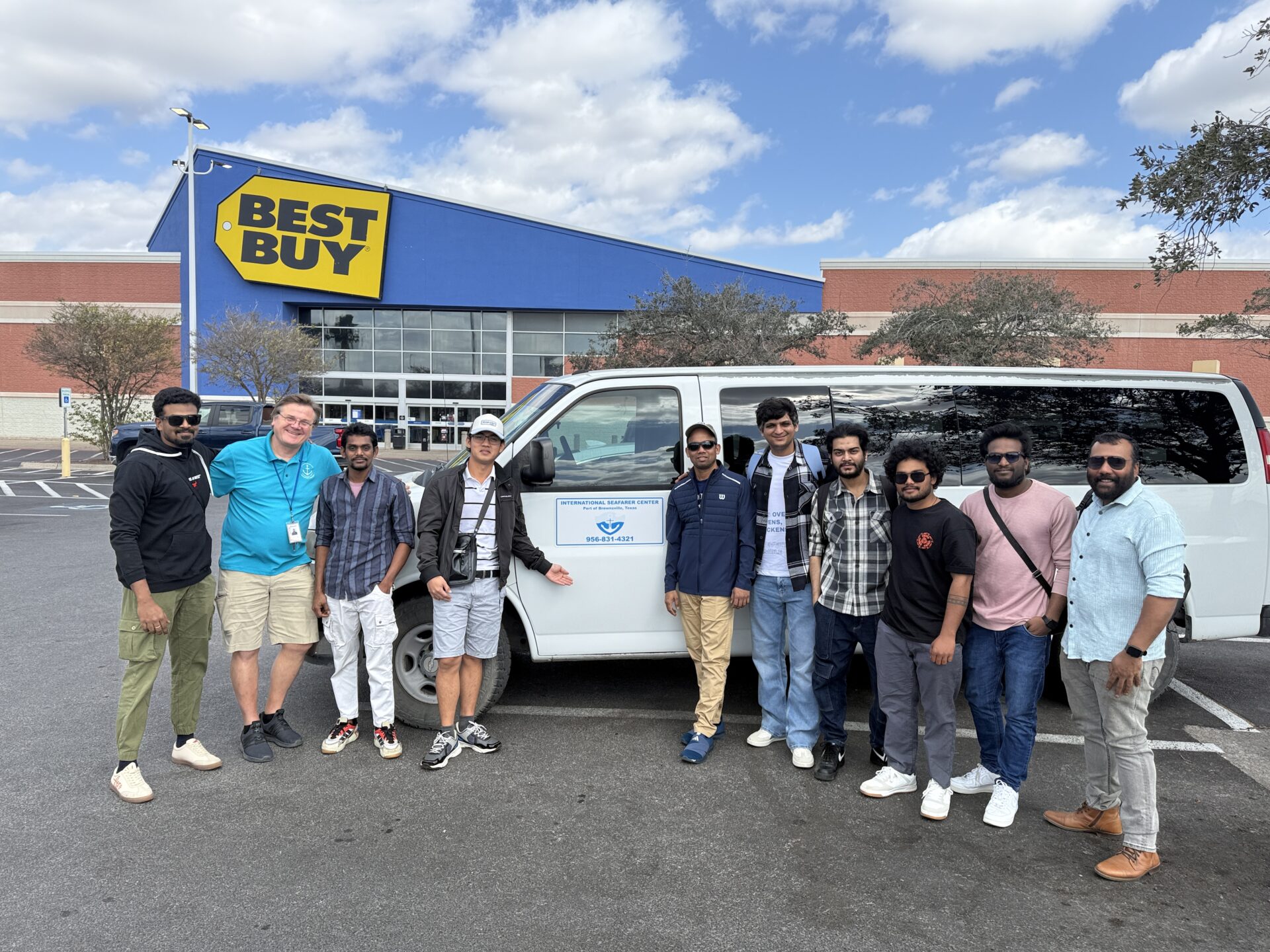
I had the privilege of joining him for one such pickup. We arrived at the gangway and soon the van was completely full—mostly Indian nationals, one Filipino. They were a lively group, laughing, talking over one another, and visibly delighted at the chance to go ashore. Several said that in other ports they did not get this opportunity. Brownsville, for them, felt different.
They boarded quickly, but first had to wait while CBP checked their documents. Then we drove into the city. On the way, Andreas carefully explained the geography of shore leave in Brownsville. Best Buy was the furthest, the mall in the middle, Walmart a long additional hike. The distances between them were considerable. It underscored the challenge of walking in a port city built for cars, not pedestrians. Shore leave here is not a simple stroll; it requires planning, coordination, and trust.
On the way into town, the conversation was practical. “On the way in… it’s mainly business. It’s Where are you going? What do you want to do? Where do I pick you up? Where do I drop you off?” he told me later. The van is a moving operations center. But the return trip is different. “On the way back, they’re happy. They’ve had their break, and it’s that time that we get to interact.” It is then that ministry opens up in unexpected ways. “I get to discover who they are, discover where they are in the faith, if they’re in the Christian faith, and I want to encourage them. If they’re not, I want to be a witness of Christ to them.”
As we drove, I watched how naturally this happened. The seafarer in the front seat becomes the primary conversational partner. “Usually the guy in the front seat… is the guy that I talk to, and then others, you know, they’ll listen in and respond.” The van becomes a small, temporary community. Laughter mixes with questions about family, contracts, faith, and life at sea. The time is short, but it is real.
When I asked Andreas why providing SIM cards and shopping runs should be considered ministry, he answered without hesitation. “They lead very confined lives on board ships,” he said. Shore leave allows them “to sort of be a human being out of the work environment, to stop being a cog in the Great Machine.” For some, it is simply sitting in a restaurant for a few hours and “just feel sort of human and then go back to work.” For others, especially before going home, it is buying gifts to “show their love and appreciation.” These ordinary acts—eating, shopping, calling home—restore dignity.
After decades of this work, Andreas speaks not first of logistics but of the heart. “It’s a servant role,” he reflected. The technical aspects are learned quickly. The deeper lessons come in moments of delay and frustration. “If I cannot keep my heart in the right place towards those that I serve, then… I lose the door for ministry.” The pressures are real—back-to-back trips, someone late for pickup, constant coordination—but the greater challenge is internal. “It’s really learning about my own heart as I am a servant to those that come and visit the port of Brownsville.”
When I asked what encouragement he would give to someone considering this ministry, he spoke of joy. “The joy is giving people the opportunity to be human, to go ashore, to do something for their family, something for themselves, and to participate in that.” It is a simple description, yet profound. The chaplain does not control cargo flows or shipping schedules. He drives a van. He waits at gangways. He answers questions. He listens. And in doing so, he participates in restoring a measure of humanity to men who spend months at sea.