

Addressing a Growing Crisis: Seafarer Abandonment at CMA Shipping 2026
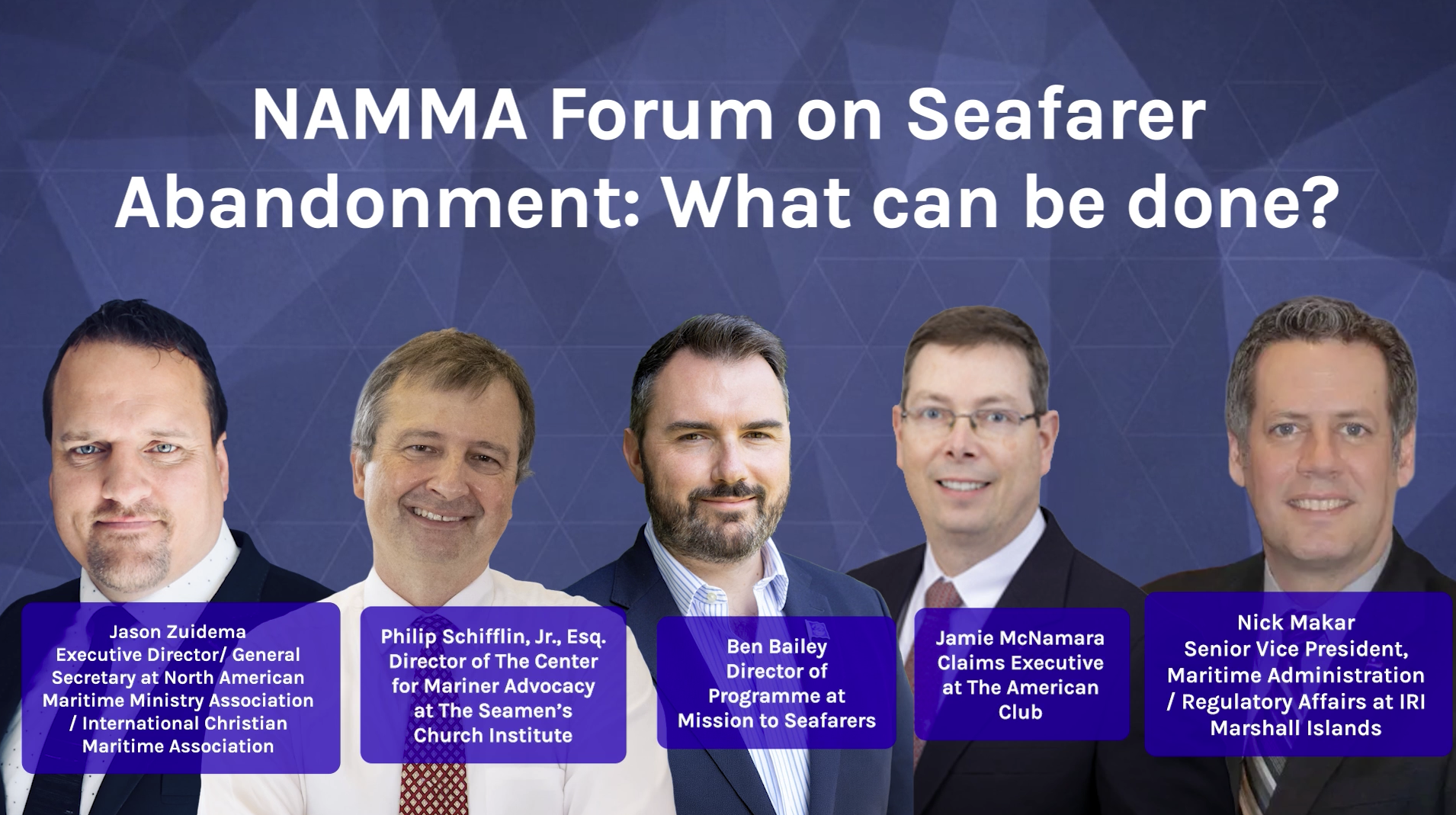
At the CMA Shipping 2026 conference in Stamford, Connecticut, the North American Maritime Ministry Association (NAMMA) convened a timely and urgent forum on one of the most pressing humanitarian issues in global shipping today: seafarer abandonment. Held on the morning of March 12, the panel brought together legal, insurance, welfare, and regulatory perspectives to grapple with a crisis that has reached record levels—and to ask a critical question: what can actually be done to stop it?
From the outset, the tone was clear. This was not meant to be a theoretical discussion. As moderator Jason Zuidema noted in his opening remarks, the issue of abandonment is constantly in the news, with more than 400 vessels and thousands of seafarers affected in the past year alone. But rather than simply recounting statistics or sharing stories, the goal of the session was practical: to identify concrete steps that could “move the needle” and prevent another record year.
The panel reflected a deliberately broad range of expertise. Philip Schifflin, Esq. of the Seamen’s Church Institute brought a legal and advocacy lens; Jamie McNamara of the American P&I Club offered an insurance perspective; Ben Bailey of The Mission to Seafarers grounded the discussion in frontline humanitarian response; and Nick Makar of International Registries, Inc. provided insight into flag state responsibilities. Together, they painted a complex but deeply interconnected picture of the problem.
What emerged early in the discussion was the importance of relationships within the maritime sector. McNamara emphasized that the industry is, at its core, a close-knit community where trust and communication matter. Crew well-being, he suggested, is not just about compliance or systems, but about fostering a sense of shared responsibility—what he described as the “second family” that develops on board ships. Yet even within such a community, gaps remain, and those gaps can widen into situations as severe as abandonment.
From the regulatory side, Makar highlighted the central role of the Maritime Labour Convention (MLC), which has, over the past two decades, established a global framework for seafarers’ rights and welfare. The MLC’s principle of “no more favorable treatment” was designed to ensure that ships are held to consistent standards regardless of where they operate. In theory, this should create a level playing field. In practice, however, enforcement remains uneven, particularly when vessels operate in jurisdictions that lack robust oversight.
If the regulatory framework provides the structure, the lived reality of abandonment was brought into sharp focus by Ben Bailey. Drawing on the work of The Mission to Seafarers, particularly in the Middle East, he described cases where crews go unpaid for months, stranded at anchor without adequate food, water, or fuel. In some instances, chaplains and welfare workers are not simply offering pastoral care—they are delivering basic survival supplies to crews who have been effectively cut off from their employers. These are not isolated incidents but recurring patterns, often exacerbated by legal and logistical complexities in regions where union representation is restricted or absent.
Bailey also made an important distinction between different types of abandonment. Some cases arise from genuine financial collapse, where companies fail and ships are left in limbo. Others, however, involve deliberate strategies by shipowners to evade responsibilities—reflagging vessels, exploiting legal loopholes, or simply disappearing. In these cases, abandonment becomes not just a failure of the system but an abuse of it.
Philip Schifflin provided a helpful framework for understanding how abandonment is defined under the MLC. While the most extreme cases involve complete withdrawal of support—no wages, no provisions, no communication—the convention also recognizes abandonment in less visible forms, such as failure to pay wages for two months or failure to repatriate crew at the end of their contracts. Each of these scenarios carries serious consequences for seafarers, many of whom support families who depend on their income.
From this diagnosis, the conversation turned toward solutions. One recurring theme was the importance of financial security, particularly through Protection and Indemnity (P&I) insurance. When valid P&I coverage is in place, seafarers have a direct avenue to claim unpaid wages and secure repatriation. However, as Schifflin noted, problems arise when that coverage lapses—often quietly—while vessels continue to operate. Strengthening verification mechanisms, especially at the port state level, could significantly reduce the risk of abandonment by ensuring that ships entering port have active and valid insurance.
This led to a broader discussion about the role of port states. Although the MLC places primary responsibility on flag states and shipowners, abandonment typically occurs in ports. Yet port states often lack clear obligations or standardized procedures for responding to such cases. The IMO and ILO have developed guidelines to address this gap, offering what Schifflin described as a “playbook” for coordinated action. The challenge, however, is awareness: many stakeholders are simply not familiar with these guidelines, limiting their impact.
Education emerged as another critical area. Several panelists pointed out that seafarers themselves are not always aware of their rights under the MLC or how to access support mechanisms. Training—both for seafarers and for those responsible for enforcing regulations—could enable earlier intervention and prevent situations from escalating. As McNamara noted, even basic awareness of when abandonment begins could prompt crews to seek help sooner, rather than waiting months in increasingly dire conditions.
There was also discussion of accountability mechanisms. Bailey raised the possibility of stricter due diligence by flag states, suggesting that shipowners with a history of abandonment should face consequences, including restrictions on registration. Makar responded by noting that such issues are already being examined at the IMO, including efforts to address fraudulent registries and improve oversight of vessel ownership and compliance.
As the session drew to a close, the sense of urgency remained palpable. The scale of the problem—thousands of seafarers abandoned each year—stands in stark contrast to the limited attention it receives in the wider public sphere. As Bailey observed, similar numbers in other industries would likely trigger immediate and widespread response. In shipping, however, the issue remains largely out of sight.
The panel did not claim to have solved the problem. But it did succeed in clarifying both the complexity of the challenge and the pathways forward. Better enforcement of existing regulations, improved coordination between flag and port states, stronger verification of financial security, and enhanced training and awareness all offer tangible opportunities for progress.
Perhaps most importantly, the session reaffirmed the human dimension of seafarer abandonment. Behind every statistic is a crew member waiting for wages that never arrive, a family dependent on income that has stopped, a person stranded far from home with limited options. As Zuidema concluded, the goal must be not only to discuss these realities but to act on them—to ensure that the next set of statistics tells a different story.