

Behind Every Number: What the First Global Register of Seafarer Fatalities Tells Us
For generations, seafaring has been recognised as a hazardous profession. Seafarers spend long periods away from home and family, work in demanding environments, and face risks to their physical and mental health that are unlike those encountered in many occupations ashore. Yet despite widespread recognition of these dangers, it has remained surprisingly difficult to answer a basic question with any precision: how many seafarers die at sea, and what causes their deaths?
A new report from the International Labour Organization is beginning to provide some answers. Released on 23 June 2026, the Global Register of Fatalities at Sea for 2024 represents the first official collection of data under a new international reporting system. An experimental data collection was conducted last year, but the 2024 register marks an important step towards establishing a more consistent global picture of seafarer deaths.
The origins of the register go back to the Special Tripartite Committee of the Maritime Labour Convention, 2006, which in June 2022 agreed on amendments intended to improve the reporting and analysis of seafarer fatalities. Those amendments entered into force on 23 December 2024. The purpose is straightforward but important. Better information about why and how seafarers die can help governments, the maritime industry, welfare organisations and others identify risks and take steps to prevent future deaths.
The first official collection demonstrates both the value of that effort and the work that remains to be done. Responses were received from 74 countries, of which 66 submitted data on fatalities. Some responding countries reported that no ships fly their national flag, while others indicated that relevant data were not currently available. Some countries also provided information concerning deaths among their own national seafarers.
The resulting figures do not therefore represent every seafarer death around the world. The ILO itself acknowledges that country coverage is not yet comprehensive. Nevertheless, the data offer valuable insight into the characteristics and emerging patterns of fatal incidents involving seafarers.
A total of 449 deaths were reported by the 66 countries providing fatality data. By a considerable margin, the largest category was illness and disease, accounting for 245 deaths. Occupational accidents accounted for 86 deaths, while 36 people died in person-overboard incidents. There were 26 reported deaths by suicide, 14 cases that remained under investigation or for which the cause was unknown, and 13 deaths attributed to other causes.
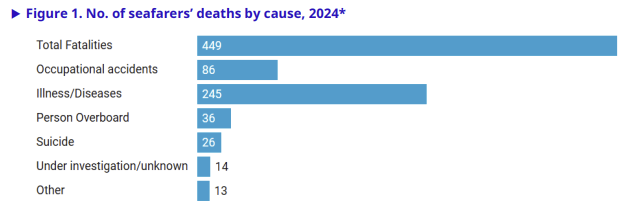
The prominence of illness and disease is particularly striking. Discussions about safety at sea can naturally focus on accidents, storms, machinery, falls and other immediately visible dangers. Yet this first official register suggests that the health of seafarers deserves at least as much attention. More than half of the deaths reported in the register were attributed to illness and disease.
For those who provide healthcare, welfare, pastoral care and social services to seafarers, that finding deserves reflection. Protecting life at sea is not simply a matter of preventing accidents. It also means considering access to healthcare, the early identification of illness, opportunities to seek medical assistance, working and living conditions aboard ship, and the broader factors that affect physical and mental health during long periods at sea.
The report also provides a clearer picture of who is represented in the fatality statistics. Men accounted for 98 per cent of reported victims. Ratings accounted for nearly half of recorded fatalities. The report examines fatalities by rank and cause and notes that “the proportion of deaths due to occupational accidents was higher among deck personnel than among engine personnel, reflecting greater exposure to physically demanding and high-risk tasks in open and dynamic environments.”
Age data were available for 315 fatalities. Of these, 85 per cent involved seafarers aged 30 or older, while 14 per cent involved seafarers between 19 and 29 years of age. One reported fatality involved a seafarer aged between 16 and 18. The limited data mean that it would be unwise to draw broad conclusions about the risks facing particular age groups at this stage, but future editions of the register may allow patterns to become clearer.
Location is another important part of the picture. Around 60 per cent of the reported fatalities occurred at sea. The report also examines ship type and other characteristics, although the first collection does not necessarily indicate that these factors have an overwhelming influence on mortality.
Mental health has understandably been an important concern in discussions about seafarer welfare, and suicide was one of the five primary causes specifically included in the questionnaire. There were 26 reported suicides in the 2024 data. These deaths are deeply significant, and efforts to improve seafarers’ mental health and access to support remain essential. At the same time, the first register places suicide within a broader picture in which illness, disease and occupational accidents account for considerably larger numbers of reported deaths. As reporting improves, the register should provide a stronger evidence base for understanding the relative scale of these different risks.
Perhaps the most important caution is that 449 should not be read as the definitive number of people who died while working at sea worldwide in 2024. The register records fatalities captured through this particular reporting system. Not every country provided fatality data, national reporting systems vary, and other maritime sectors may be represented through different systems. Fishing, in particular, presents a much wider global safety challenge and is often the subject of separate international statistics and estimates.
This helps explain why other figures for deaths at sea can be substantially higher than the total contained in the new register. It also points towards an important area for future research. Comparing the register with national casualty records and other international sources could help identify where deaths are not yet being captured and whether particular countries, trades or maritime sectors account for a disproportionate share of fatalities.
In that sense, the importance of the register may not lie in providing a final number. Its importance is in establishing a process. As more countries report, definitions become more consistent and national systems improve, it should become possible to build a clearer and more reliable picture of mortality among seafarers. That knowledge can then inform practical action.
The report itself makes the point simply: “Ensuring the safety of seafarers requires a clear understanding of the risks they face.” Reliable and consistent data are fundamental to achieving that understanding. Better standardisation and stronger reporting practices will make future editions of the register even more valuable.
There is, however, a danger whenever we discuss mortality through statistics. Numbers can make human loss seem abstract. The 449 deaths in this report were not simply entries in a database. Each represents a person whose life ended while part of the seafaring community. Behind those figures are families, friends, shipmates and communities who experienced a loss.
For organisations serving seafarers, remembering those in peril on the sea means remembering that human reality. Data can tell us where risks lie and where resources may be needed, but its ultimate purpose is to protect people. Every fatality better understood may contribute to another fatality prevented.
The first official ILO Global Register of Fatalities at Sea is therefore an important beginning. It does not yet tell us everything we need to know about deaths at sea, and its limitations should be recognised. What it does provide is a foundation from which governments, the maritime industry and those who care for seafarers can ask better questions, identify patterns and work towards better prevention.